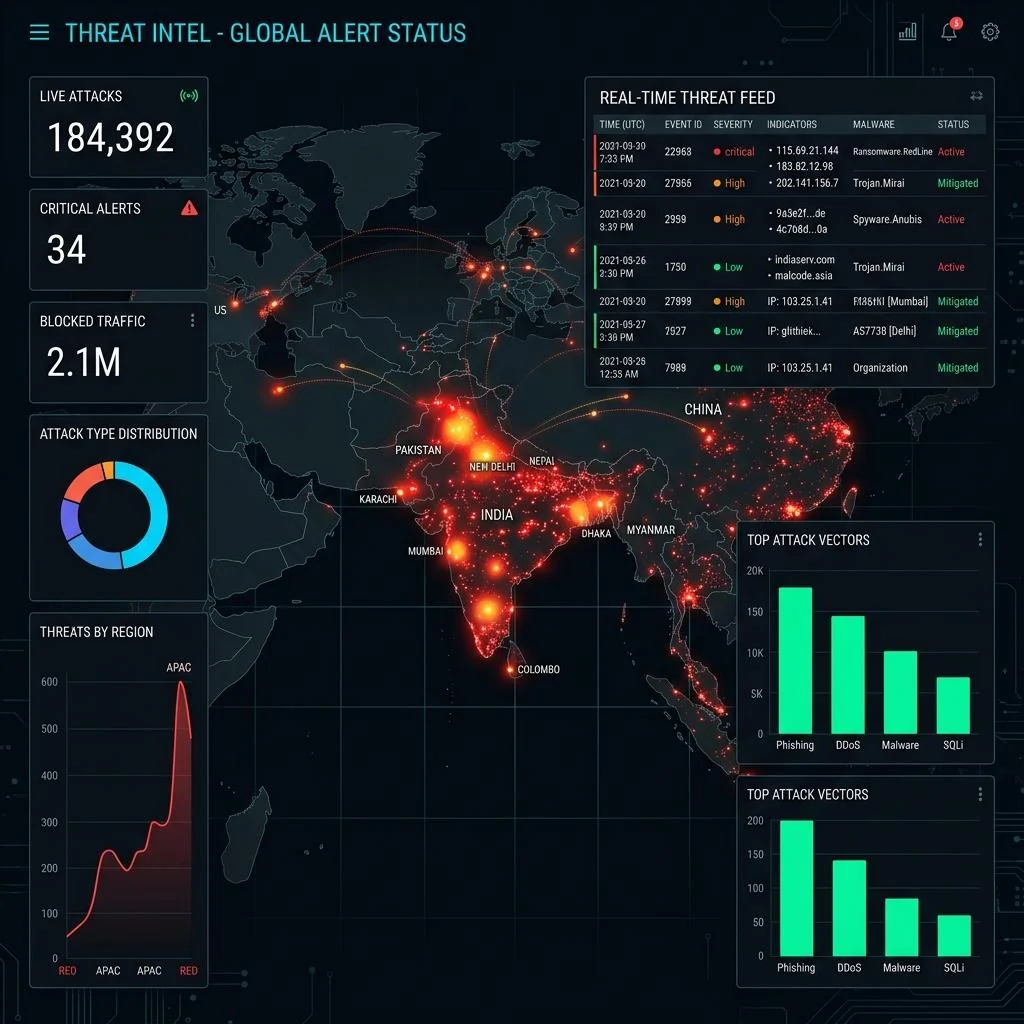

What Is Threat Intelligence? A Practical Guide for Modern Businesses
Cybersecurity is no longer only about reacting after an attack happens.
Modern organisations need to understand what threats exist, who may target them, which vulnerabilities matter, and what indicators could signal an emerging attack.
This is where cyber threat intelligence becomes important.
Threat intelligence helps organisations transform security information into actionable knowledge.
Instead of simply asking:
“What happened?”
Security teams can also ask:
“Who might be targeting us?”
“How could they attack?”
“What indicators should we monitor?”
and
“What should we do next?”
What Is Threat Intelligence?
Threat intelligence is the process of collecting, analysing, and interpreting information about cyber threats to help organisations make better security decisions.
It can include information about:
- Threat actors
- Malware
- Attack techniques
- Vulnerabilities
- Malicious domains
- IP addresses
- File hashes
- Phishing campaigns
- Attack infrastructure
- Exploitation trends
The important word is intelligence.
Raw information is not automatically intelligence.
Security teams need to analyse information and determine what it means for their organisation.
Types of Threat Intelligence
Threat intelligence is commonly divided into several categories.
Strategic Threat Intelligence
Strategic intelligence focuses on the broader threat environment.
It can help business leaders understand:
- Major cyber risks
- Industry threats
- Geopolitical developments
- Emerging attack trends
- Business-level cyber risk
Tactical Threat Intelligence
Tactical intelligence focuses on how attacks are performed.
It may examine techniques, tactics, and procedures used by threat actors.
Operational Threat Intelligence
Operational intelligence focuses on active or emerging campaigns.
It can help security teams understand how specific threat activity is developing.
Technical Threat Intelligence
Technical intelligence focuses on technical indicators.
Examples include:
- IP addresses
- Domains
- URLs
- File hashes
- Malware indicators
Why Threat Intelligence Matters
Organisations can have firewalls, endpoint protection, SIEM platforms, and other security tools.
But security tools become more effective when they have relevant context.
Threat intelligence can help organisations:
- Identify malicious infrastructure
- Prioritise vulnerabilities
- Improve detection rules
- Support threat hunting
- Investigate incidents
- Understand attackers
- Strengthen security controls
Threat Intelligence and the SOC
Threat intelligence can provide valuable context to SOC analysts.
Consider an alert involving an unfamiliar IP address.
On its own, the alert may not provide enough information.
Threat intelligence could reveal that the IP address is associated with:
- Malware infrastructure
- Previous attacks
- Phishing activity
- Command-and-control infrastructure
That additional context can help analysts prioritise the event.
OSINT and Threat Intelligence
Open-source intelligence, commonly known as OSINT, can also contribute to threat intelligence.
OSINT involves gathering and analysing information from publicly available sources.
Security professionals may examine:
- Public websites
- Domain information
- Technical infrastructure
- Public documents
- Security research
- Public breach reports
- Social platforms
- Threat research communities
When used responsibly and legally, OSINT can provide valuable context for cybersecurity investigations.
Threat Intelligence Is More Than a Feed
One common misconception is that buying a threat intelligence feed automatically creates a threat intelligence capability.
It does not.
Organisations need processes for:
Collection → Processing → Analysis → Validation → Dissemination → Action
The intelligence needs to reach the people and systems that can actually use it.
For example:
Threat intelligence could inform:
- SIEM detection rules
- Firewall controls
- Endpoint security
- Incident response
- Vulnerability management
- Security awareness
- Executive risk decisions
Building a Threat Intelligence Program
Organisations can start with a practical approach.
1. Define your objectives.
Determine what questions your threat intelligence programme should answer.
2. Identify relevant threats.
Focus on threats that could realistically affect your organisation.
3. Collect reliable information.
Use appropriate internal and external sources.
4. Validate information
Not every threat indicator is accurate or relevant.
5. Analyse the data.
Determine what the information means for your environment.
6. Turn intelligence into action.
Update detections, controls, investigations, and security priorities.
Threat Intelligence and Proactive Security
Traditional cybersecurity can become heavily reactive.
An organization detects an incident, investigates it, and responds.
Threat intelligence introduces a more proactive dimension.
Security teams can monitor emerging threats and ask:
“Could this affect us?”
before an incident occurs.
That shift can improve organisational preparedness.
The Future of Threat Intelligence
Threat intelligence is becoming increasingly connected with:
- AI
- SOC automation
- OSINT
- Threat hunting
- Security analytics
- Vulnerability management
AI can help process large volumes of information, while human analysts provide context and validation.
This combination can make threat intelligence more useful and operationally relevant.
Final Thoughts
Threat intelligence helps organisations move from simply collecting security information to understanding what that information means.
When integrated with SOC analytics, OSINT, cybersecurity monitoring, and AI automation, threat intelligence can become a powerful part of a modern security strategy.
At iXecurity, we help organisations understand their digital threat landscape and build security capabilities around threat intelligence, OSINT, SOC analytics, cybersecurity, and intelligent automation.
Understand the threat. Strengthen the defence.